
So you’ve decided to take the plunge and make the move. Where do you start?
First off, you need a visa. There are various options – ancestral visas, global talent visas etc. – but since we came over on a Skilled Worker Visa (SWV), I’ll focus on that one. If you have ancestral ties to the UK, the ancestral visa is your simplest (albeit likely not cheapest) option – see the gov.uk website for more information.
Unfortunately, it’s not just a matter of packing your bags and coming to the UK – the SWV requires some effort! There are numerous requirements and it is costly, but it is very well documented and absolutely possible to do without paying an agent. In short, the SWV allows you to come to/stay in the UK to do an eligible job with an approved employer, as well as bring your dependants along (with some caveats).
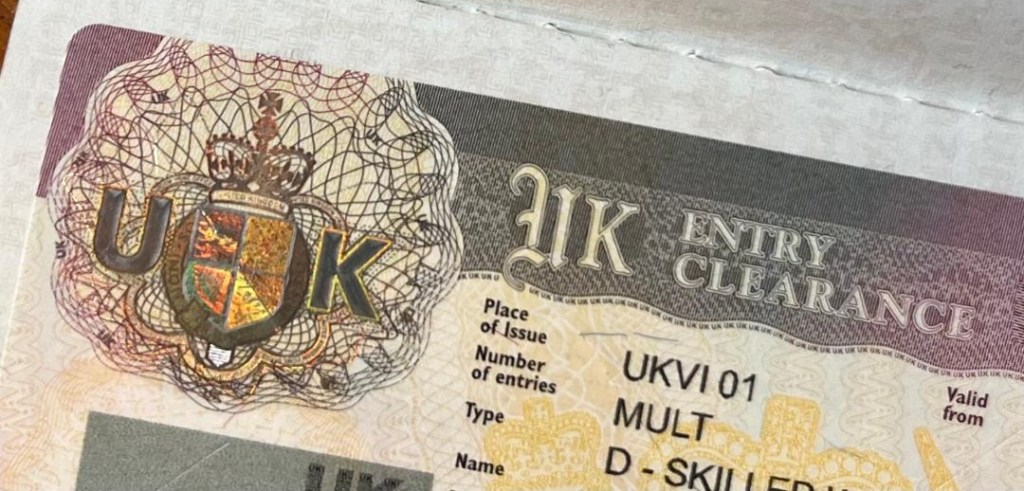
To get a SWV, you must:
- Work for an employer approved by the Home Office
- Have a Certificate of Sponsorship (CoS) from your employer
- Do a job on the list of eligible occupations
- Be paid a minimum salary (currently £41,700 per year, or the ‘going rate’ for the type of work you do – whichever is higher. How much you need depends on your occupation code and the date you get your CoS). The minimum salary may be lower in certain limited instances – check the gov.uk website!
Every job has an occupation code – you use this code to search the online database to see if your job is eligible. If your occupation code is listed as ‘higher skilled’, you can apply. If it is listed as ‘medium skilled’, you can only apply if your job is on either the immigration salary list or the temporary shortage list.
Your visa can be valid for up to 5 years. You will need to extend it after this period, and also update it if you change jobs or employers. After 5 years, you may be eligible to apply for ILR (Indefinite Leave to Remain).
You cannot apply for benefits (public funds) or the State Pension (but you can contribute towards a future pension through monthly National Insurance payments), and you cannot change jobs or employers unless you secure SWV sponsorship from another employer. If you bring dependants with you, their visas are linked to your visa. That means if your visa is cancelled, withdrawn, or curtailed, theirs will be too. A dependant visa allows your spouse or partner to work in any job (with the exception of being a professional sportsperson or coach), study, and access the NHS – but they must maintain valid immigration status tied to yours.
Visa holders no longer receive a physical Biometric Residence Permit (BRP) card upon arrival – you’ll receive a digital immigration status (eVisa). This status serves as proof of your right to live and work in the UK, and you’ll need it for things like renting a home, proving your right to work, and opening a bank account. When travelling in and out of the UK you must be able to show this status on your UKVI (UK Visas and Immigration) account in order to be allowed to travel.
As a visa holder (whether main applicant or dependant), you are entitled to access the NHS (National Health Service) after paying the IHS (Immigration Health Surcharge). This means you can register with a GP and access most medical services without additional cost — though some things like dental care and prescriptions carry extra fees, even for UK citizens.
When looking for a job, the key is to find an employer that offers sponsorship – and it’s not necessarily easy – but they do exist! An employer can also register as a sponsor if they are eligible and willing.
Once you accept a UK job offer, prepare to have money for:
- The visa application fee (£769–£1,751). Sometimes an employer covers this, but there is no obligation – they’re only legally required to cover the cost of the CoS.
- The healthcare surcharge (currently approx. £1,035 per person per year). Again, this is sometimes covered, but it’s not mandatory.
- Funds to support yourself on arrival (minimum £1,270 as per gov.uk – but we suggest additional funds for start-up costs like immediate accommodation, linen, crockery, electronics, home basics, rent deposit, etc. If you’re planning on purchasing a car/similar note that your credit record does not transfer internationally and you will start on 0 here, so have enough money for that if needed).
You apply for the visa online and upload the required support documents – sometimes your employer handles the process and you just attend the biometrics appointment, but not always.
Documents you’ll need:
- CoS reference number
- Employer name and sponsor licence number
- Proof of English proficiency
- Valid passport with blank pages
- Job title and salary
- Occupation code
- Bank statements (proof of funds)
- Proof of relationship (if including spouse/children as dependants)
- TB test certificate (from approved clinic only – see info here)
- Academic documents (if required)
- Police clearance (if required)
Tip – if your passport is close to expiring (or I would say within 2 years), renew it before applying even though you’ll be paying a small penalty fee in ZAR (usually double the rate for a new passport)! Renewing from the UK is a lengthy, painful and expensive (in GBP) process. If you plan to travel often, get a maxi passport and save yourself the headache.
Yes – go check your passport now… I’ll wait.
Dependants
I am in the UK as a dependant on AM’s SWV. This is a separate application and approval is not guaranteed. You need to provide proof of your relationship and proof of funds to support yourself. Besides our marriage certificate, we also submitted a photo presentation of our life together and affidavits from family and friends – better to oversupply than undersupply!
My visa is valid for the same duration as AM’s. As mentioned earlier, I am allowed to work in any field (except as a professional sportsperson or coach), study, travel in and out of the UK, access the NHS, and apply for ILR after 5 years if eligible. I cannot claim benefits or State Pension (but can contribute to National Insurance if I work). Sometimes an employer will do this application on your behalf and/or cover the costs, but there is no obligation on them to do so – we did my application ourselves.
Main Applicant Timeline
| Date | Milestone |
|---|---|
| 01 Apr 2024 | Started UK job applications. |
| 17 Apr – 08 May 2024 | Interviewed with various employers. |
| 15 May 2024 | Received job offer. |
| 22 May 2024 | Accepted offer. |
| 16–21 Jun 2024 | Ecctis English proficiency assessment. If you’ve completed any tertiary-level education in English, the Ecctis assessment offers a simpler and more affordable alternative to traditional English language tests such as IELTS or Pearson PTE. It’s a great option to consider if you’re looking to prove your English proficiency without taking a formal exam. |
| 20 Jun – 03 Jul 2024 | Applied for a new (maxi!) South African passport. This set our overall application timeline back by two weeks. AM’s previous passport had just two blank pages left – insufficient for upcoming travel, so the delay was worth it. |
| 25 Jun – 29 Aug 2024 | Security clearance. Although not typically required for UK visa applications, AM’s role necessitated a much deeper level of security vetting – well beyond the standard police clearance. This added complexity and ultimately dictated our overall timeline. Fortunately this ran in parallel with the visa application process. |
| 04 Jul 2024 | Received TB certificate. |
| 08 Jul 2024 | Submitted visa application via AM’s employer’s agency. |
| 24 Jul 2024 | Lodged visa application with UKVI. |
| 29 Jul 2024 | Biometrics (photo and fingerprints captured). |
| 14 Aug 2024 | Visa Granted! Received passport with entry clearance vignette. This isn’t your full SWV – just a vignette allowing first-time entry to the UK. Resigned and served 30-day notice period. |
| 18 Sep 2024 | Departed to the UK. |
Dependant Timeline
| Date | Milestone |
|---|---|
| 05 Oct 2024 | Online visa application + IHS payment. |
| 07 Oct 2024 | TB test and certificate received. Biometrics (photo and fingerprints captured). |
| 12 Oct 2024 | Visa granted! The attached letter confirming the decision was dated 9 October 2024 – just 3 days after lodging the application! |
| 15 Oct 2024 | Received passport with entry clearance vignette. |
| 15 Nov 2024 | Departed to the UK. |
The gov.uk website is thorough and your best friend here – everything you need is there, clearly broken down. There are exceptions (e.g. where the employer covers fees), but these are indicated clearly online.
Disclaimer: This blog post is for information purposes only and does not constitute legal advice. Immigration rules change often and personal circumstances differ. For the most up-to-date and authoritative information, please refer to the official UK government website at gov.uk.

 RedLipsRedNails